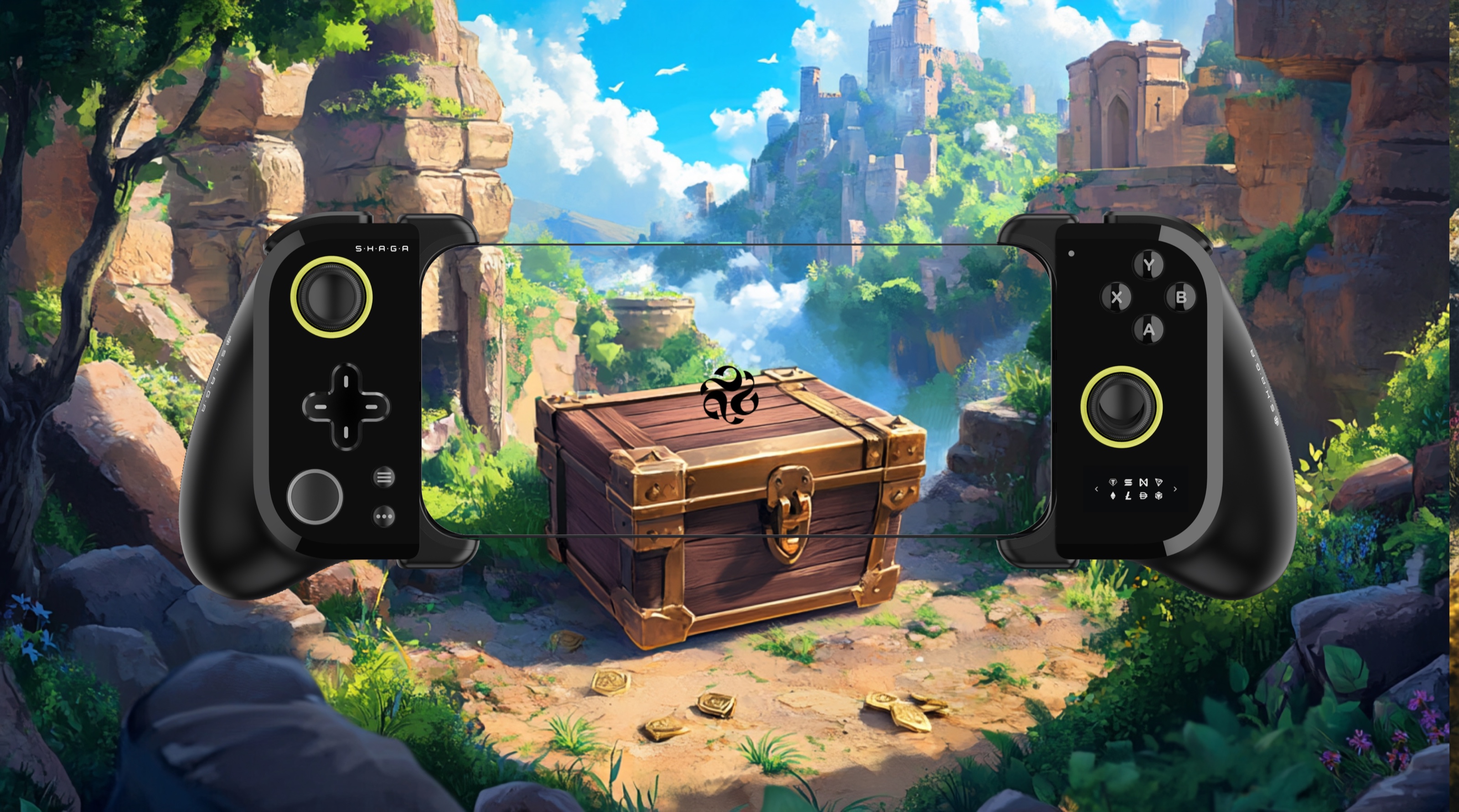
Shaga handheld controllers and reward chest staged inside a game world

BRAND · PRODUCT · Feb 2024 – Oct 2024

Shaga

Founding product designer across UX/UI, brand, creative direction, and the $GLOB engagement concept

Timeline
Feb 2024 – Oct 2024
Role
Founding Product Designer (Full-time)
product designer
Founding
$GLOB concept
Originated
Process & contextStrategy, decisions, outcomes, chronology, and sources

Context

Shaga had a cloud-gaming product across desktop and mobile, but limited marketing reach and no coherent system connecting participation, progression, community status, and repeat engagement.

Product decision

I independently conceived, designed, and branded $GLOB as a social-token approach to that reach problem, presented it to the marketing and executive teams, and found Frankie Labs to help make the idea executable. In parallel, I gave the core streaming, reservation, onboarding, and mobile flows one product language.

Outcome & evolution

The initial proposal challenged a more traditional marketing model. Product and marketing iterated it into a points program before launch, preserving the core loop of quests, progression, status, and brand participation. Shaga continued promoting $GLOB through engagement quests after my tenure; the launched implementation evolved cross-functionally from the original concept shown here.

Founding
product designer

UX/UI, branding, and creative direction across the company.

Originated
$GLOB concept

Independent strategy, product framing, identity, and internal pitch.

Launched
points program

Iterated cross-functionally and used across quests and brand engagement.

ScopeProduct Strategy, UX/UI, Brand Identity, Creative Direction, Campaign Systems
Sources & prototypes

Key decisions

Turn a reach problem into a product loop

Rather than treating limited marketing reach as a media-spend problem, I proposed $GLOB as a social token: participation would compound through quests, progression, visible status, and reasons to return.

Design the idea as a brand and a system

I created the name, identity, interaction model, and campaign world together so $GLOB could live inside the product, travel through social channels, and remain recognizable as it evolved.

Find a path from concept to execution

After presenting the proposal to marketing and leadership, I identified Frankie Labs as an execution partner. The product and marketing teams then adapted the social-token thesis into the points program that shipped.

Keep the core product coherent

Alongside $GLOB, I owned the web and mobile UX for streaming, reservations, onboarding, profiles, parties, and social presence so the engagement layer strengthened one product instead of becoming a separate destination.

Project chronology

Nine months across the product and its participation layer

The role moved between the cloud-gaming foundation, the mobile social system, and a new engagement model. The sequence keeps those workstreams connected without collapsing them into one launch claim.

01

The original $GLOB thesis

I originated $GLOB as a social-token approach to a marketing-reach problem: make brand participation cumulative, visible, and worth returning to. The identity and product model were conceived together before the proposal evolved cross-functionally into the launched points program.

The original $GLOB product vision: chapters, participation, progression, and status.

02

$GLOB as a launch world

The launch film introduced the system as a living network of players, status objects, and collective momentum rather than a conventional points announcement. Motion made the participation model understandable before the interface had to explain it.

$GLOB launch film - a participation system staged as a live network.

03

A campaign that looked like a network

The identity made participation feel larger than an isolated points balance. A repeated $GLOB field established the campaign world; the global map showed individual player objects accumulating into shared momentum.

The $GLOB wordmark behaving as a field rather than a static campaign lockup.
Participation visualized as a live global network of player identities.

04

Progression people could see and keep

$GLOB gave participation a legible arc. Quests created repeatable actions; levels and collections made progress and status visible across desktop and mobile.

The full levels and quest system across breakpoints.
A collectible reward surface staged consistently across mobile and desktop.

05

One engagement platform across breakpoints

The system was designed as a responsive product, not a desktop campaign with a reduced mobile version. Quests, claims, balances, collection progress, and the shared Glob retained the same hierarchy while adapting to the intent and space of each device.

Desktop and mobile engagement surfaces built from the same quests, progression, identity, and collection model.

06

Rank turned points into identity

I translated accumulated $GLOB points into a player rank system inspired by the immediate status clarity of Halo 2. Numbered tiers made early progress easy to read; rarer icon ranks gave long-term participation a more distinctive destination. The rank then became part of the Shagatag instead of living as a detached balance.

The proposed progression: accessible numbered tiers followed by rarer, identity-led ranks.
Rank carried into the Shagatag alongside avatar and handle.

07

One quest, designed across states

A repeatable quest needed to explain availability, reward, completion, and the next return without leaving the campaign world. I designed the mobile lifecycle and desktop card as one interaction system rather than separate promotional surfaces.

Mobile quest states - available, rewarded, complete, and returning.
The same Spin Glob loop translated into the desktop campaign surface.

08

A daily action with a complete return loop

Spin the Glob turned one lightweight action into a clear daily cadence: available, in progress, rewarded, complete, and ready to return. The interaction made participation visible on the shared Glob while resolving the player’s reward immediately.

Operation Spin the Glob - the active spin, motion state, and immediate $GLOB reward.

09

Spin the Glob

The daily quest was designed as a compact motion loop: an available state, a spin that reveals the reward, and a cooldown state that gives the player a reason to return. The three-frame storyboard shows how the interaction carried progression, anticipation, and repeat behavior in one object.

Spin Glob animation storyboard - available, reveal, and cooldown states.

10

From abstract points to a playable object

I tested the progression system as a tactile arcade counter before resolving it into the raffle power-up experience. The exploration was useful because it made accumulated points feel physically playable rather than leaving them as an abstract balance.

Working-file exploration: rank, Glob count, and increment controls staged as an arcade object.
The resolved raffle power-up arcade carried that physical interaction language into the campaign.

11

The Glob Machine became a web interaction

I translated the raffle mechanic into a browser-based arcade machine. Wallet state, entry quantity, and the transaction action stayed legible, but the experience felt like operating an object rather than completing a form. The interaction extended the campaign world without introducing a second product model.

Glob Machine web interactive - connect a wallet, choose an entry quantity, and enter the raffle from one arcade object.

12

Give the raffle a collectible form

Rather than let entry read like another points transaction, I explored a ticket system that made the raffle feel tangible and collectible. Serial codes, Glob geometry, and reward states carried the participation language into a physical artifact. This was a design direction, not evidence of production or distribution.

Raffle-ticket mockups - the entry mechanic staged as a collectible physical artifact.
Ticket-system exploration - modular layouts, serial codes, Glob geometry, and reward states.

13

Clan growth loop

An exploratory growth concept turned referrals into a shared clan journey: invite friends, complete onboarding quests, and make progress visible as a group. The system gave each new player a reason to bring the next person in instead of treating acquisition as a one-time link.

Clan onboarding: referral paths, quests, and rewards designed to make the first session social.
Clan dashboard: progress, referral growth, and shared status in one view.

14

A physical reward object

The same clan idea extended beyond the interface into collectible packaging. These box concepts explored how a reward could feel like a status object players wanted to receive, photograph, and pass through the community.

White reward-box direction.
Black reward-box direction.

15

$GLOB in product

After product and marketing iteration, the launched points program carried the core idea through quest dashboards, progression states, claim actions, and seasonal launches.

Quest dashboard and seasonal progression system.

16

A result designed to be shared

Marking the Glob ended in a compact, location-specific completion card. Rank, place, and status made the result legible at a glance, turning a completed daily action into public proof of participation without adding a separate social product.

Operation Mark Glob - a compact completion artifact for Hanoi.

17

Players carried the artifact outward

Players began sharing the state of the live Glob outside the product. The response turned participation into visible social proof and briefly pushed the experience beyond its performance limits.

Community response after players collectively marked the Glob.

18

A tactical language for cloud play

The intro framed Shaga as an active gaming network rather than another utility client. Tactical pacing, system signals, and a live-state aesthetic established the product world before the interface made the underlying infrastructure legible.

Tactical intro — the cloud-gaming network framed through play, signal, and system readiness.

19

The core streaming product

As founding product designer, I also owned the platform beneath the engagement layer: node setup, streaming state, reservation, onboarding, and the paths connecting desktop play to mobile coordination.

Node lobby - play state, progression, and social presence in one readable surface.
Gameplay stays central while the social layer remains present.
Streaming feedback staged as a clear, atmospheric system state.

20

UX architecture behind the interface

The complete Node model connected game selection, lobby state, social presence, streaming controls, and system feedback before the visual layer was applied.

Desktop streaming architecture and interaction paths.

21

Designing the native Node lifecycle

A second desktop journey resolved the Node itself: launch, sign-in, network profiling, game discovery, lobby configuration, node activation, social drop-in, game selection, streaming overlay, switching games, and ending a session. Mapping the host and player states together made the invisible infrastructure legible without turning the experience into a server dashboard.

Native desktop Node journey - onboarding, first-run configuration, lobby creation, live gameplay, and session control.

22

Node UX revisions with the Ukraine team

I oversaw a Ukraine-based agency as they iterated the Node experience, directing the visual and UX improvements across the hosting state, game list, social rail, and overall system atmosphere. The revision moved the interface toward a clearer Glob Network direction while keeping the game and player state legible.

Node UX revision review - current direction compared with the Glob Network background treatment.

23

The complete Node UX

The full Node map shows how those states connect across setup, game discovery, lobby creation, network and hardware checks, gameplay, social presence, streaming controls, and session exit. It made the infrastructure legible as one continuous experience rather than a collection of disconnected screens.

Complete Node UX map - the full flow from launch and setup through gameplay, social states, and session end. Click to inspect the high-resolution map.

24

A journey ready for engineering

I translated the mobile streaming concept into a complete path from launch and account creation through game discovery, connection quality, lobby matching, controller setup, rotation, and play.

The end-to-end MVP journey, annotated with states, system behavior, and engineering requirements.

25

The hackathon MVP

The earliest sprint collapsed identity, nearby-player discovery, connection state, and joinable play parties into one pitchable mobile concept. It was a hackathon artifact, not the product system that followed, but it helped test whether one Shagatag could anchor discovery and coordination across cloud gaming.

Early hackathon promo board: Shagatag identity, nearby players, joinable parties, and network state assembled into one concept.

26

Social discovery before visual polish

I compared list, map, selected-player, and live-lobby models before committing to a visual direction. Location only earned its place when it advanced coordination: see who is nearby, understand their state, then act. The next pass added network quality because proximity alone did not make a cloud-gaming session joinable.

Four early discovery models: list plus map, spatial presence, selected-player actions, and the handoff into a joinable lobby.
Intermediate network-scan direction: identity, active play, capacity, and fast, good, or poor connection states in one feed.

27

Converging one language across identity and play

The May studies tested how Shagatag identity could survive across onboarding, the activity feed, the marketing surface, and an in-game social rail. I narrowed the work toward a calmer system where player identity and session state stayed legible over changing game worlds.

Early cross-surface study connecting account creation, Shagatag identity, mobile activity, the web story, and an in-game social rail.
Focused convergence preview; open the full board to inspect the light, dark, and image-led directions.

28

The mobile UX system, mapped end to end

The MVP board connected feed, onboarding, profiles, game discovery, parties, reservations, and return states into one mobile product model before the visual system was applied.

High-resolution mobile UX architecture board: the system behind the client experience.

29

Information architecture, revision two

This IA pass connected the mobile feed, lobby, friend discovery, profile editing, blocking, party states, controller connection, and gameplay handoff into one product journey.

Mobile IA — MVP revision 2, mapping the client from sign-in and feed through friends, parties, and play.

30

Critical flows beyond the happy path

The broad journey boards hide essential product work. I also mapped account entry and friend search as explicit state systems — validation, username selection, avatar setup, empty states, and progressive results — so identity could survive the handoff into social play.

Account architecture — remembered identity, validation, third-party entry points, username creation, avatar selection, and completion.
Friend search — empty and progressive result states inside the live presence system.
High-resolution mobile UI board: social presence, squads, invitations, and game-session states.

31

Profiles as social state

Editing a profile was part of the presence system, not a detached settings form. The flow covers naming, avatar selection, confirmation, cancel behavior, and the return to the live feed.

Edit profile flow: change identity, select a profile image, confirm, or return without saving.

32

The lobby, reworked for mobile

The newer Figma direction brought lobby discovery, reservations, social presence, and profile controls into the same product language as the desktop experience.

Lobby discovery, live sessions, and social presence.
The Shagatag and active-game system in context.
Updated mobile lobby, reservation, and profile direction.
Reservation states and return-to-lobby logic.

33

A later concept turned refresh into a network scan

Building on the earlier discovery work, I explored pull-to-refresh as a scan for nearby players and active sessions. Distance, party capacity, join intent, and identity were layered onto the network-quality model so the feed helped coordinate play rather than becoming another generic social timeline. This direction remained exploratory, not shipped.

Game in session - distance, player identity, active title, and party capacity in one scan.
Lobby forming - nearby identity, open party capacity, join intent, and the referral loop.

34

Building the Glob world

The visual direction connected the product's global participation model to arcade hardware, planetary forms, status objects, and a more physical gaming culture.

Visual references, interface studies, and the arcade-world direction.

35

Identity as a system

Identity marks, stickers, labels, and status objects.
Quest-season campaign system.
A flexible language of identity marks, event graphics, power-ups, warnings, and physical stickers.

36

Identity carried player state

The Shagatag combined level, avatar, presence, and balance into one compact object that could travel across maps, profiles, parties, and campaigns.

Level, balance, avatar, and presence explorations for the Shagatag.

37

The hardware world

The same identity expanded into a handheld controller concept and a campaign world built around access, discovery, and reward.

Handheld controller campaign at billboard scale.
Controller and reward-world concept.
The controller staged as a portal into the reward world.

38

A brand world that supported the product

Packaging and campaign work gave cloud gaming a physical, culturally legible presence. It follows the product work here because it amplified the system; it was not the system itself.

Controller packaging.
Energy drink packaging.

39

Solana Breakpoint collateral

Conference collateral translated the controller world into partner-specific poster moments: a clear pre-order offer, QR-led conversion, and a shared Shaga story that could travel across gaming communities.

Lowlife Forms × Aurory poster — pre-order offer, QR conversion, and partner rewards.
Star Atlas poster — pre-order offer, QR conversion, and the controller staged as a gaming artifact.

40

Solana Breakpoint sticker system

The sticker set turned the Breakpoint language into portable objects: the Shaga.xyz mark, DePIN and globe symbols, level and identity badges, and a playful Glob warning label.

Warning-label detail: the object communicated rules, scarcity, and status before the campaign explained them.
Molecule can system.
Whitelist campaign extending the Molecule object into a launch mechanic.
The Molecule object in motion — packaging treated as a rotating status artifact, not a static campaign prop.

41

Believe in Something

Rather than explain the handheld through specifications, the campaign led with a simple cultural position. The film connected product, place, and brand into one repeatable invitation, then extended that system across outdoor placements.

Believe in Something campaign film — the 29-second cut connecting the handheld, campaign world, and outdoor system.
Nine-scene billboard system.

42

A campaign built to travel

The handheld became a recognizable cultural object across landscapes and cities, while the campaign retained one consistent invitation: believe in something.

Utah.
Miami.
Singapore.
New York.
Cloud-gaming merchandise.
Cloud-gaming T-shirt system.
Social campaign.

43

Raffle launch in motion

The Molecule power-up became a complete launch sequence: a physical reward object, an arcade-like purchase moment, and a branded loop that connected the raffle back to Shaga's participation system.

Molecule raffle launch film - high-resolution cut of the power-up object, purchase flow, and $GLOB participation loop.

44

Reservation as a live product state

The reservation flow connected nearby discovery, a reserved slot, an expiry window, and the handoff into a live lobby. I treated the timer and change-reservation path as part of the social play experience rather than a utility screen detached from it.

Reservation UX: reserve a slot, manage the countdown, and join the lobby when the session opens.

45

One launch system, two surfaces

Desktop held the full arcade spectacle and campaign context; mobile compressed the same world into a focused collectible reveal and entry point. The visual language stayed continuous while the interaction density changed.

Desktop launch surface - campaign world, connected state, and arcade object.
Mobile launch surface - the same object and progression signal in a focused vertical flow.

2026 CONNOR LEE

LOS ANGELES, CA