Make identity the container
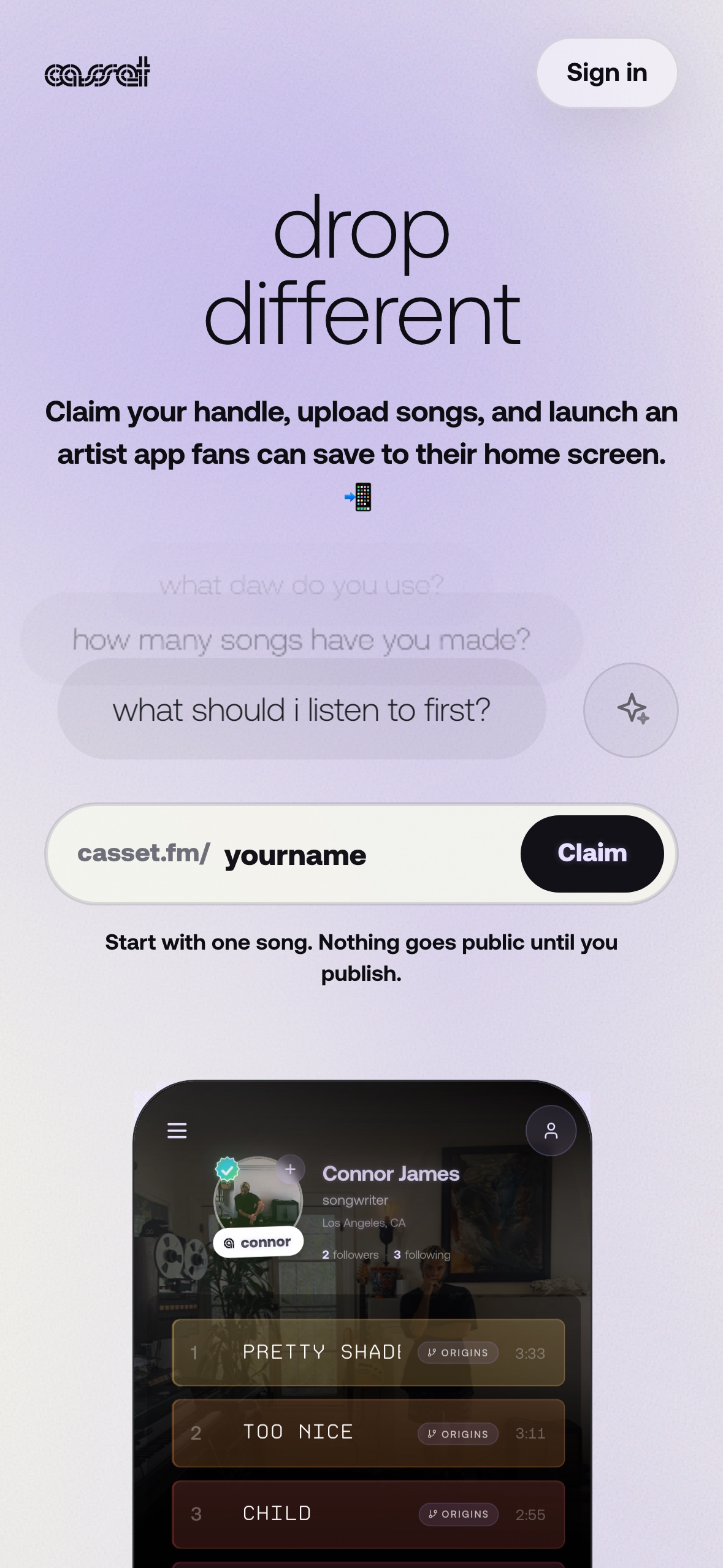
Artists and linked alter egos each get a distinct, installable world with their own visual language.
Founder · BRAND · PRODUCT · LAUNCH · Jan 2026 – Present
Founded and built immersive music worlds for artists
Problem
Music, visuals, releases, and fan relationships were scattered across platforms, leaving artists little control over the whole experience.
Approach
I connected artist worlds, audiovisual hooks, release rituals, and shared listening so music, identity, and fan participation stay together.
Outcome
Shipped creator tools, artist worlds, continuous playback, paid releases, Visual Studio, and curated Apps. Market traction remains unproven.
Key decisions
Artists and linked alter egos each get a distinct, installable world with their own visual language.
One clock synchronizes the 30-second hook, lyrics, waveform, visuals, provenance, and persistent player.
Payment or a fan-created Moment unlocks early access; the release pulse makes participation visible.
Named looks and Track DNA recommendations let artists shape atmosphere without learning the graphics stack.
Apps can restage worlds and tracks while Casset retains identity, permissions, playback, and navigation.
01
I made Profile World the container for an artist's identity, catalog, releases, access rules, and community. Linked alter egos keep independent visual worlds while one creator workspace governs them, avoiding separate products for each identity.
02
The Hook Object binds audio, lyrics, waveform, visuals, and provenance to one playback clock. Origins lets fans hold to hear the demo or sample behind a generative track, making attribution part of listening without judging the medium.
03
Artists stage a hook, release date, and unlock rule; fans enter through payment or a contributed Moment. The Release Ritual connects those actions to the release pulse and Listening Room. Collected worlds retain their identities in a fan's library, carrying the relationship beyond the drop.
04
I translated track analysis and rendering controls into named looks and editable Track DNA recommendations. Artists can shape the atmosphere, compare it against source media, and save treatments without needing to understand the graphics stack.
05
Casset Apps let developers restage artist worlds and build synchronized track experiences while the host retains the audio clock, identity, permissions, navigation, and exit. That boundary protects continuity without limiting every experience to one presentation; production Apps remain curated.
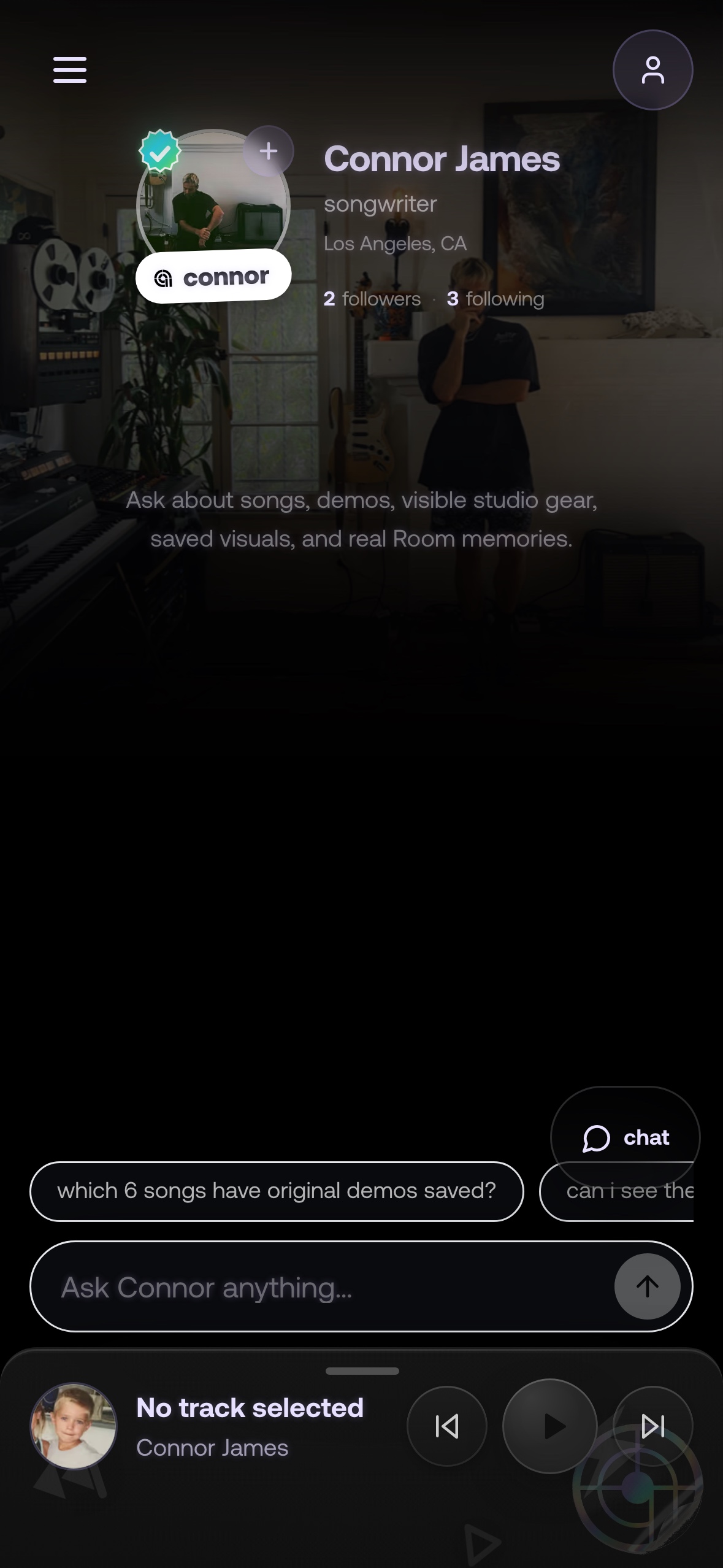
Mobile artist worlds, account creation, paid access, generative catalogs, media, and Room show how the core decisions hold together across the product.
01
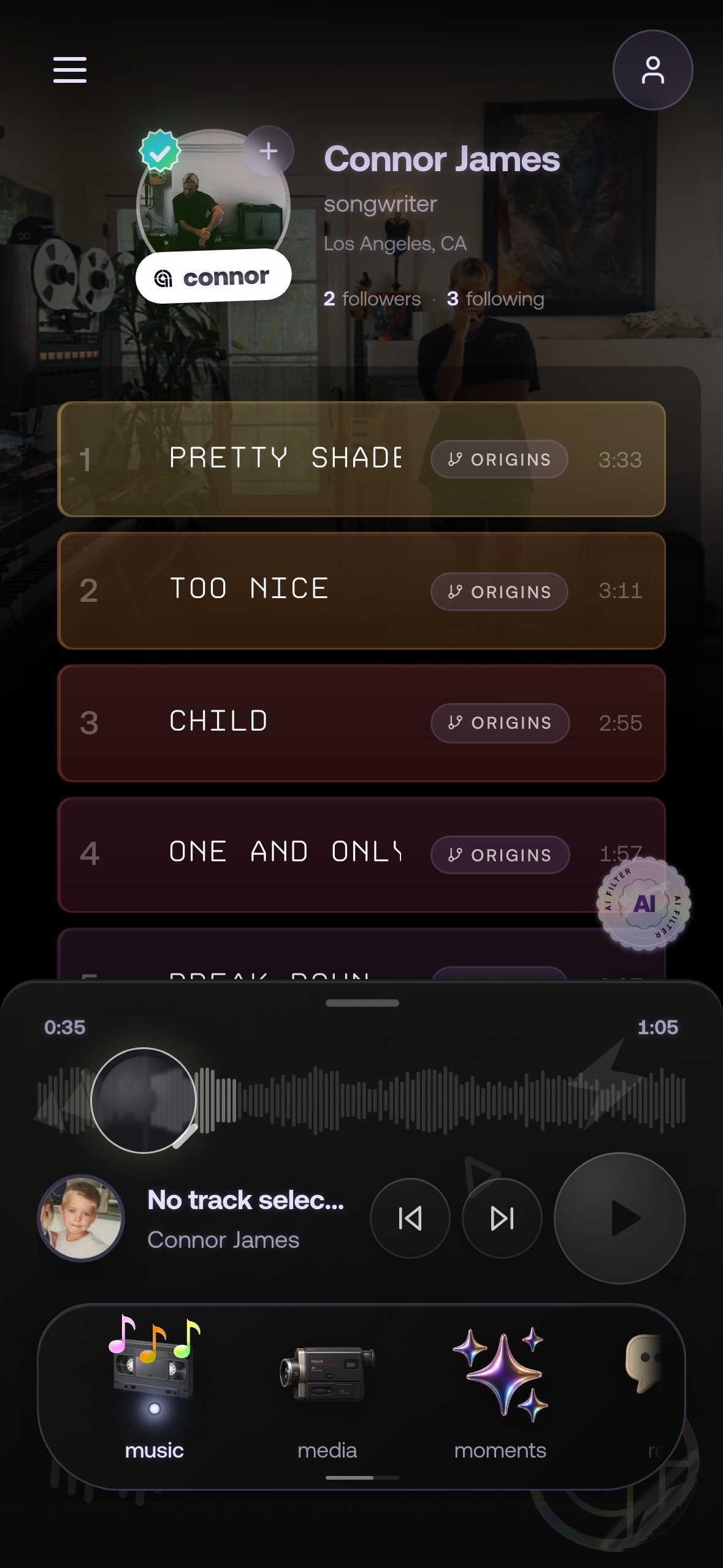
The player stays with the fan across music, media, moments, and Room.
02
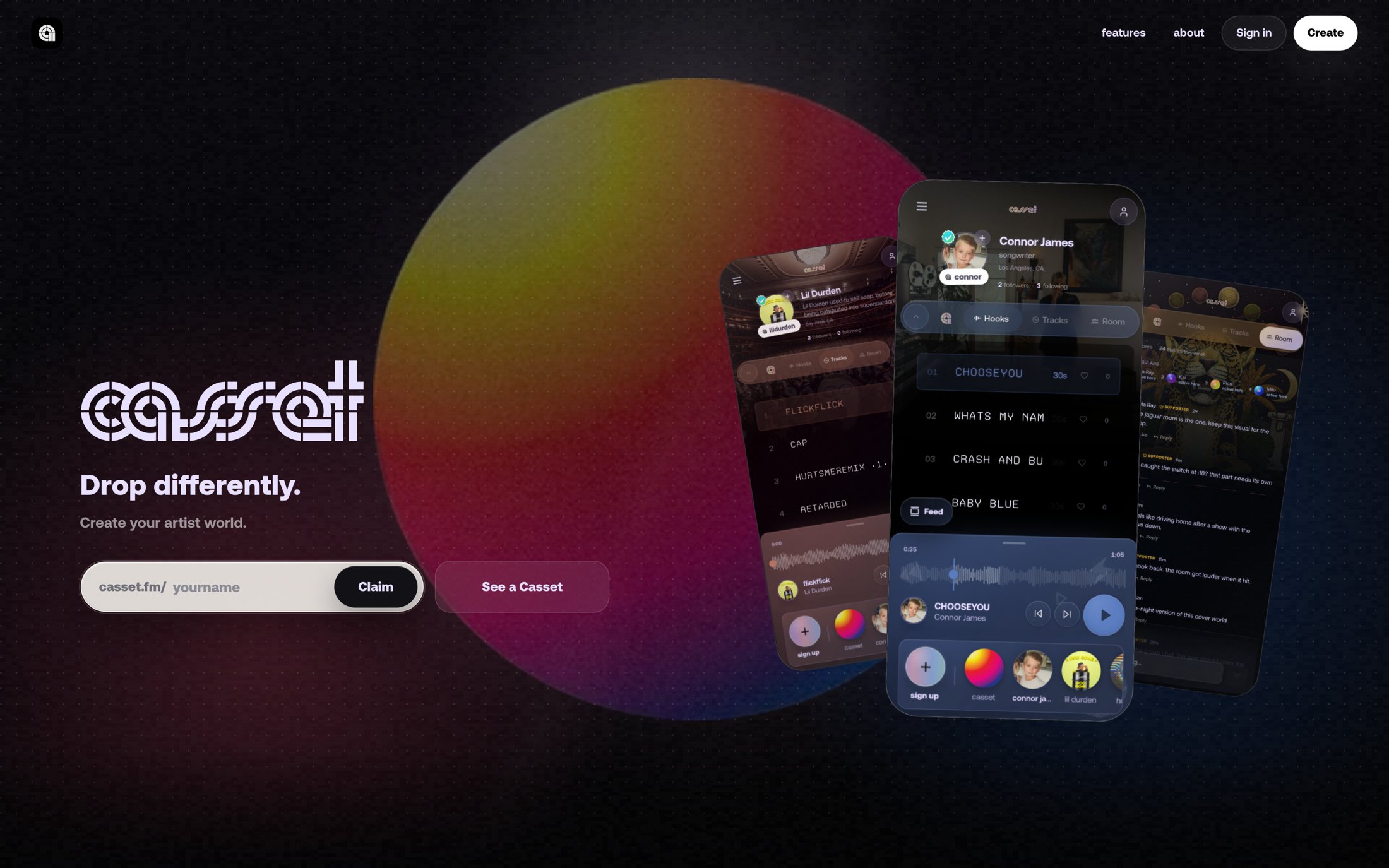
Artists claim a handle and see their world before signing up, giving them something worth saving first.
03
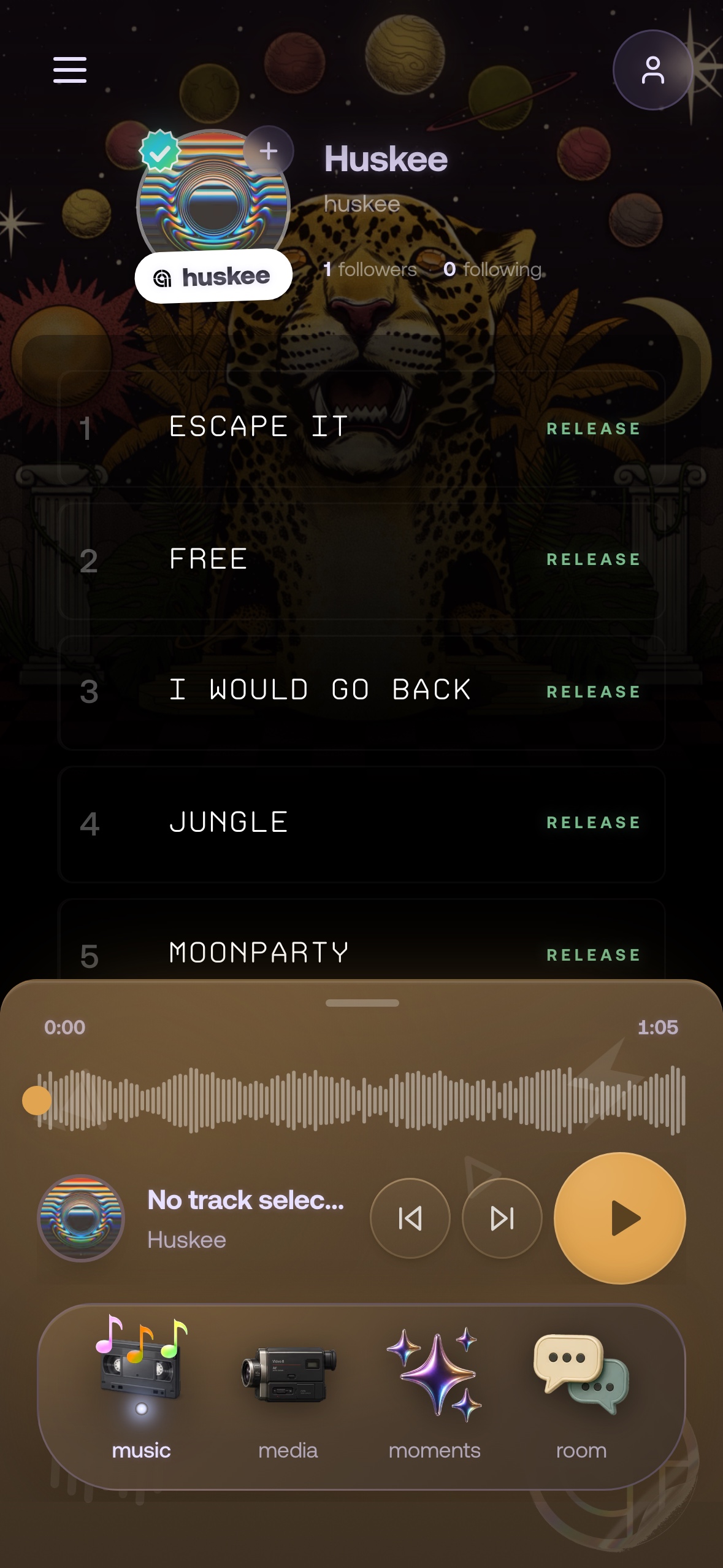
Mine and AI are clearly labeled catalogs under one artist handle. Fans choose between original work and a generative alter ego, with the same player and Room.
AI - same artist, generative alter ego. Every track carries an Origins reveal so fans can hold to hear the source.
04
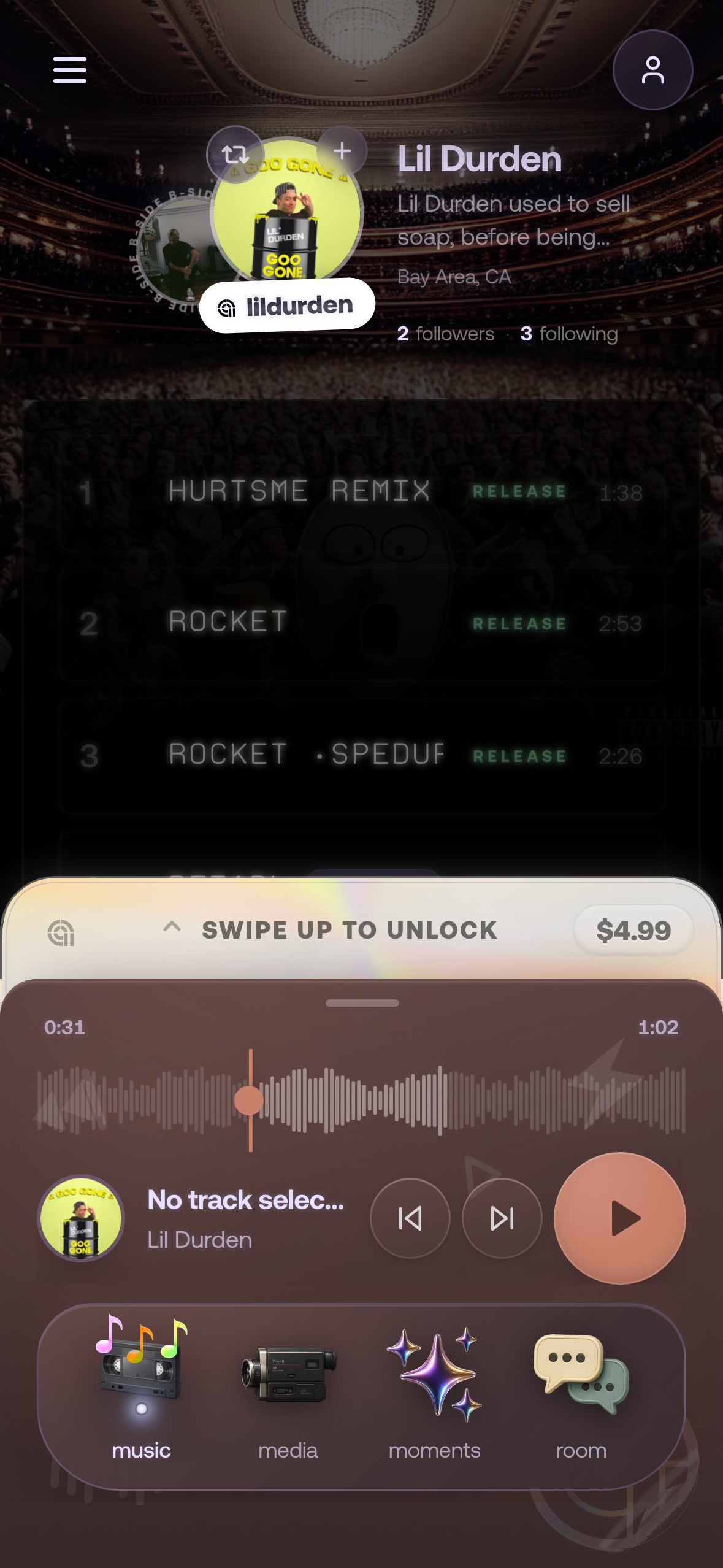
The gate inherits the artist's visual language and keeps the hook and player visible through the purchase.
Apple Pay handoff shown as an interaction mock; the in-world payment gate is the shipped product surface.
05
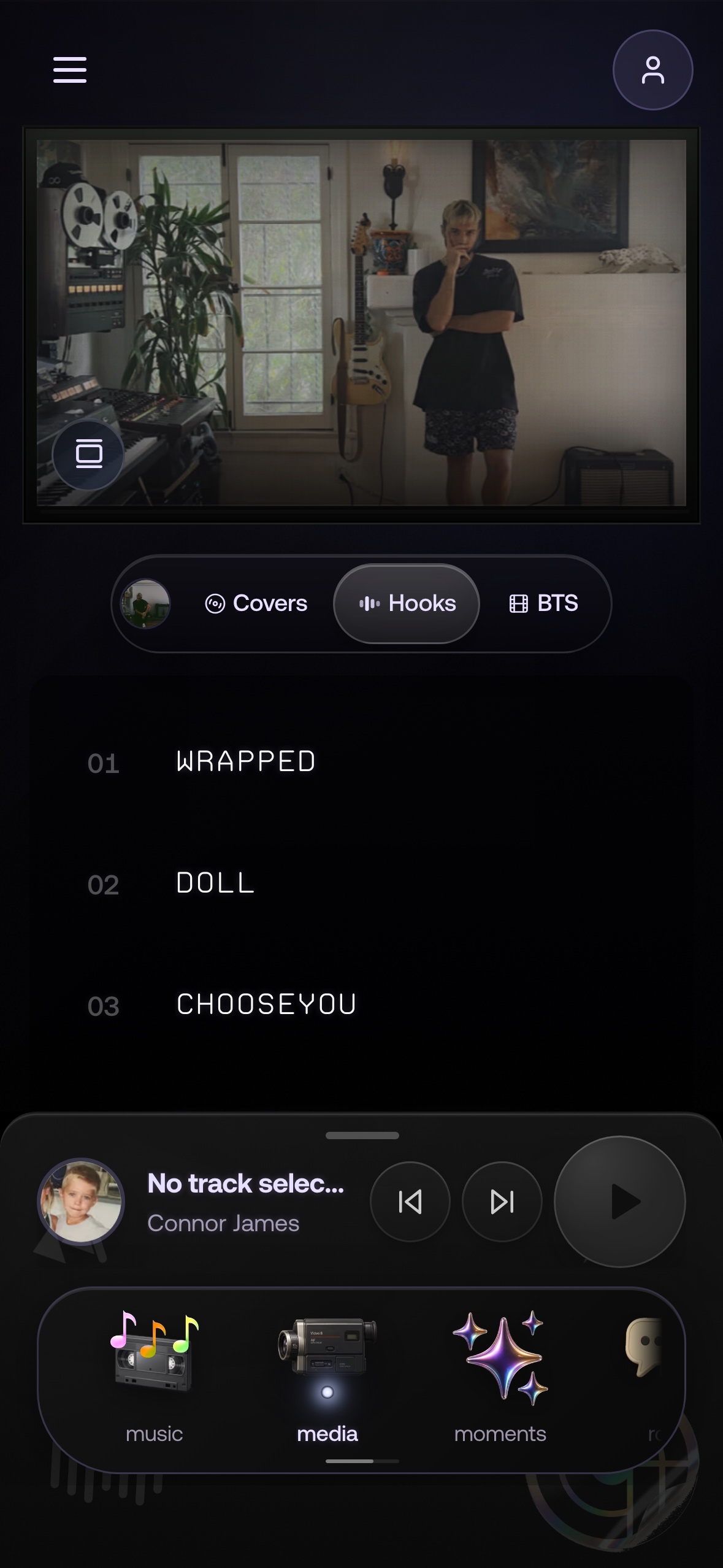
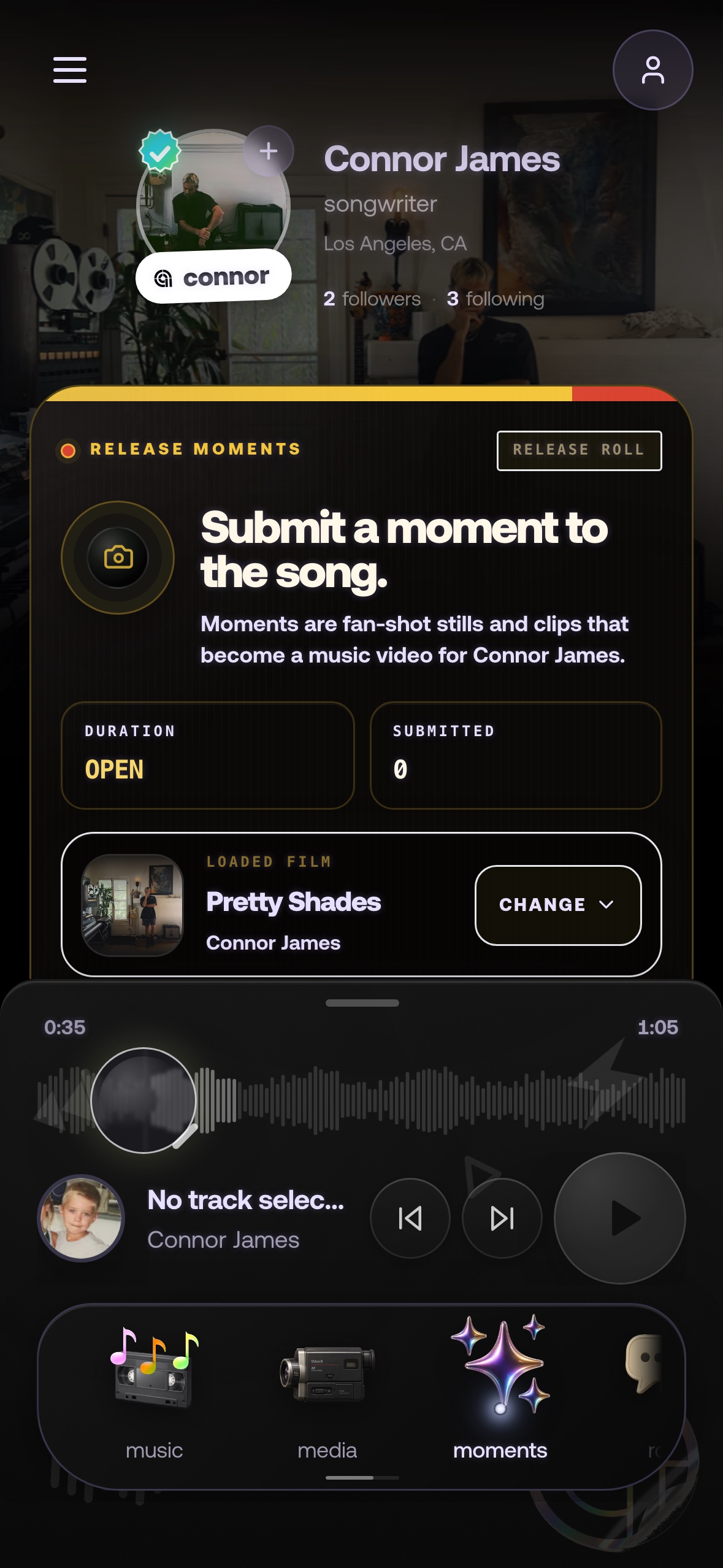
Media holds the visual archive; Moments collects fan memories. Room offers conversation grounded in songs, demos, studio context, and approved memories.
06
Color, grain, lyrics, and motion give each Hook Object its own audiovisual identity, held together by one continuous player.
The original token-launch MVP, early identity studies, and launch explorations document how the product changed. The timeline and reflection preserve the decisions behind that shift and the questions still open.
01
The first MVP launched artist coins on Base Sepolia. I retired it to focus on artist identity and release culture.
02
Poster studies established the cassette motif and the idea of artist independence.
03
Early landing studies tested artist-specific cassettes, bold typography, and light and dark directions.
04
Early landing studies tested the iridescent disc mark across light, cream, and dark treatments.
05
Campaign, outdoor, motion, and physical explorations extend the product's identity.
Project chronology
Casset became stronger by narrowing its center. This sequence shows how an early launch mechanic evolved into four connected primitives for identity, discovery, release, and shared listening.
Early build
Origin
01 / 05
The earliest Casset MVP explored tokenized music launches on Base. It proved a release could be treated as a product event, but the financial mechanism was becoming more prominent than the artist.
Phase 02
Reframe
02 / 05
Streaming profiles flatten every artist into the same catalog. Casset reframed the profile as an installable, responsive world that could hold music, visuals, identity, access, and shared presence together.
Phase 03
Interaction system
03 / 05
The Hook Object turned a short preview into a living audiovisual unit driven by one playback clock. Visuals, waveform, timed lyrics, source context, and the persistent player stay synchronized.
Phase 04
Participation
04 / 05
Artists can stage a hook, date, unlock rule, incentive, and release pulse before a public drop. Fans enter through payment or contribution, and their participation remains visible.
July 2026
Shipped system
05 / 05
The responsive platform now connects creator tools, artist worlds, route-persistent playback, early access, paid Cassets, visual production, Listening Room, curated Apps, a 0.1-alpha developer toolkit, and a documented API.
Profile World, Hook Object, Release Ritual, and Listening Room.
Creator and fan surfaces are available in production.
Strategy, identity, product design, and engineering.
Pause point · July 2026
I am pausing active development after taking Casset from a token-launch experiment to a live artist-app platform. The pause is deliberate: more solo feature work would add breadth without answering the next questions the product actually needs to resolve.
An artist app can hold identity, Hook Objects, participatory releases, persistent playback, paid access, visual creation, Listening Room, and developer-made experiences without fragmenting the artist world.
Repeat artist adoption, listener retention, paid conversion, creator economics, and demand for a third-party App ecosystem still require sustained distribution and real artist partnerships.
The next stage is not another product surface. It is focused distribution, onboarding, and learning with artists. Until that can be pursued properly, preserving the shipped system is more responsible than manufacturing momentum through feature expansion.
This case study presents shipped product evidence and product judgment. It does not claim market traction that has not been established.
The SDK, API documentation, and engineering notes show how the interaction model is supported by playback, commerce, permissions, and a bounded extension runtime.
01
The @casset/apps 0.1 alpha includes downloadable starters, typed contracts, tests, and agent instructions. Production Apps remain curated; npm publishing, public submissions, and arbitrary bundles have not shipped.
02
I documented profile reads, audio delivery, sharing, checkout, and Room events, with explicit authentication, permissions, errors, and webhook boundaries.
Casset is a single Next.js application I designed, built, and operated from January 2026, spanning authenticated audio streaming, Stripe Connect payments, realtime social systems, a machine-readable release layer, and a bounded App host contract. These July 2026 main-branch counts and implementation notes describe engineering scope, not product outcomes or an independent production audit. Counting methods have not been independently reproduced here; declared tests are not a claim that every test passed. Architecture is documented at casset.fm/docs.
Tokenized audio behind a byte-range proxy with per-request entitlement checks. Preview windows are computed server-side from bitrate estimation; no public file URLs exist.
Stripe Connect direct charges with Apple Pay and guest checkout. The July implementation describes six webhook event types and idempotent payment write paths; refund and chargeback events trigger access revocation.
Autonomous promotional drops with fraud screening. The July implementation describes four independent idempotency layers and exact ledger-to-prize-pool reconciliation before payouts, designed to prevent duplicate awards on retries.
Claude-backed visual generation and campaign intelligence: sanitized inputs, Redis cost caps, bounded structured output, deterministic fallbacks.
Redis presence and server-sent events behind comments, follows, activity, and an append-only referral ledger.
Audio-reactive visualizers and themed players driven by a shared playback clock; per-artist OG images; offline-capable PWA with tiered caching.
A repository-local TypeScript SDK gives Profile World and Track experiences bounded context and capability checks while Casset retains launch authority, playback, identity, permissions, navigation, lifecycle, and exit.
Storage, autoplay, and viewport constraints in Instagram's in-app browser shaped auth, playback, and checkout.
Suspended audio contexts, NaN durations before play resolves, background-tab garbage collection - the player recovers from each.
A single audio element owned above the router. Playback survives every navigation and powers lock-screen controls.
Every stream passes entitlement validation, served with the 206 range semantics iOS requires for seeking.
30-second hooks enforced server-side and looped client-side with a ~50ms micro-fade.
Direct charges to artist accounts, merchant-of-record duties, and dispute-driven access revocation.
Presence and SSE where connection lifetime is the constraint, with Redis as shared state.