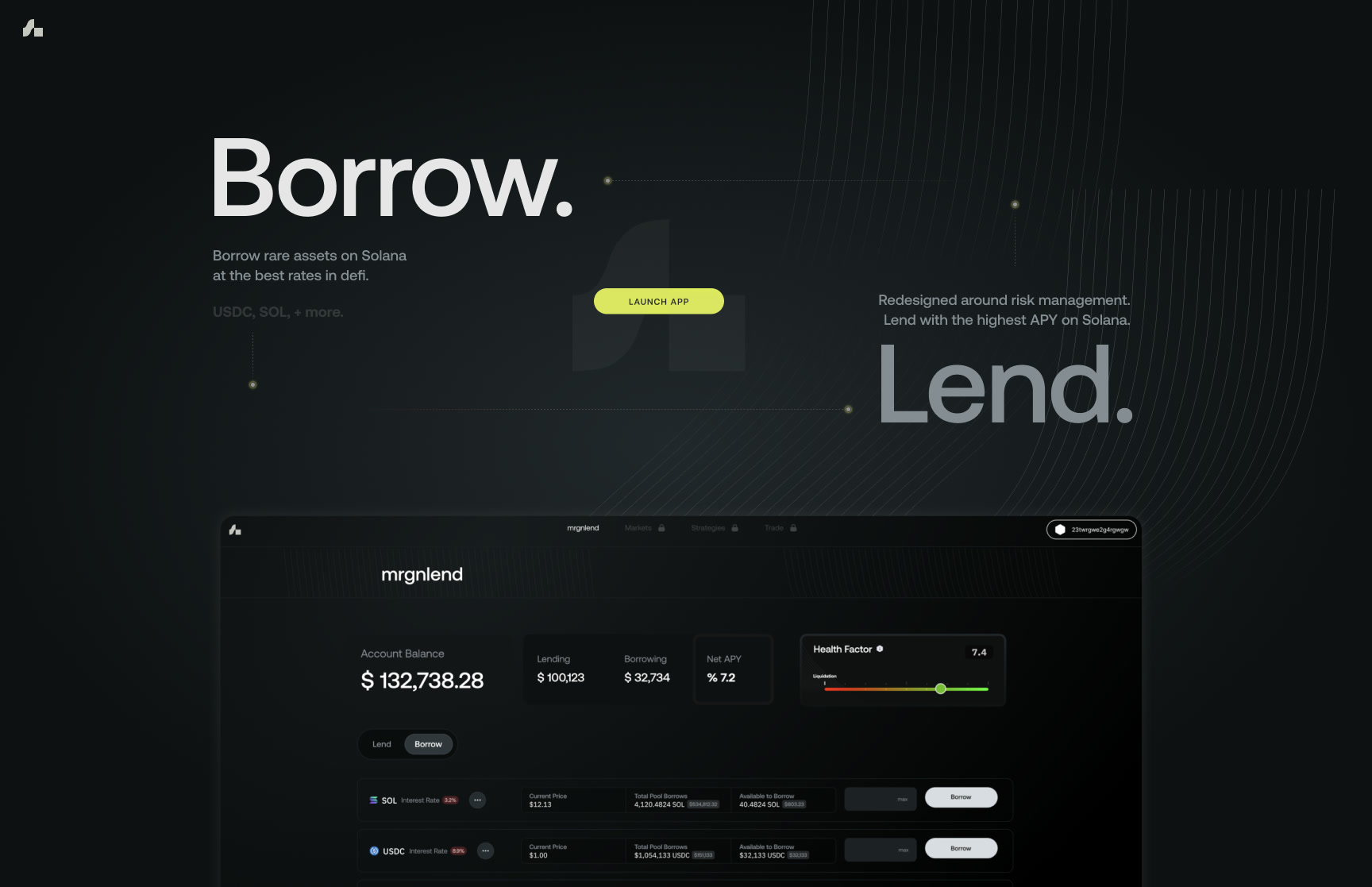
MarginFi Borrow and Lend product experience

PRODUCT · Aug 2022 – May 2023

MarginFi

Sole designer of mrgnlend - the core lending experience that scaled to hundreds of millions in TVL

Timeline
Aug 2022 – May 2023
Role
Sole Product Designer (Full-time)
product designer
Sole
later peak TVL
$800M+
Process & contextStrategy, decisions, outcomes, chronology, and sources

Context

Borrowing against volatile assets made every action a risk decision, yet DeFi interfaces often exposed protocol mechanics without helping users understand what would happen to their position.

Product decision

Make risk a first-class interaction. I organized lending, borrowing, portfolio state, and liquidation around a continuously legible health factor, then carried that model from research and wireframes into the shipped product.

Outcome & attribution

mrgnlend launched on that foundation. I left before the points program and the market expansion that followed; the product later scaled to hundreds of millions in TVL and peaked above $800M, so that growth is context - not a claim of sole causation.

Sole
product designer

Research through shipped core experience.

$800M+
later peak TVL

Reached after my departure; included with attribution.

Live
design files

Prototype, UI system, and production states are linked.

ScopeUser Research, UX Architecture, Product Design, Design Systems, Prototyping, Brand & Motion

Key decisions

Make risk continuously legible

Borrowing against volatile assets meant every action changed a user's liquidation exposure. I made Health Factor and live LTV persistent parts of the interaction rather than information users had to hunt for after acting.

Unify supply, borrow, and portfolio state

The product needed to support first deposits, active positions, market comparison, and position management without splitting one account across competing mental models. A shared asset-row and account system kept those states connected.

Design the system through edge states

I worked from research and flows into empty, connected, funded, borrowing, warning, and approval states, then iterated the core rows and controls with engineering until the interaction held together in production.

Let new products inherit a foundation

Black Box, Superstake, and Omni explored different products and interaction models, but each reused the same emphasis on legible state, explicit risk, and a coherent mrgn product world rather than becoming disconnected experiments.

Project chronology

From research model to a family of financial products

The switcher below separates distinct workstreams; this chronology shows how the risk model and interaction language moved between them during the role.

01 / 05

mrgnlend

As the sole product designer, I took mrgnlend from research and risk-model definition through UX architecture, interaction design, component iteration, and the shipped borrowing, lending, portfolio, and position-management experience. I left before the points program and major growth phase; the product foundation remained in place as the protocol later scaled to hundreds of millions in TVL, peaking above $800M after my departure.

01

The shipped lending system

mrgnlend brought supplying, borrowing, account health, and position state into one responsive surface. The product film establishes the complete interaction before the case study moves backward through the decisions that shaped it.

mrgnlend - decentralized borrow/lend on Solana

02

One account, one risk picture

The interface made account value, supplied assets, borrowed assets, available liquidity, and Health Factor readable together. Users could understand their position before choosing the next action.

The core account and market experience in context.

03

Supply and borrow without changing mental models

A shared row pattern let users compare markets, switch intent, and act without relearning the page. The surrounding account state remained stable while the action changed.

Shipped dashboard - Lend/Borrow toggle, asset rows, supplying view

04

Risk changed with the input

The LTV control updated the consequence of an action while the user was still deciding. Risk was not a warning added at confirmation; it was part of the primary interaction.

LTV slider interaction

05

Research before interface

I mapped how experienced and newer DeFi users monitored positions, compared yield, interpreted account health, and recovered from risk. That work defined the product hierarchy before visual design began.

Early UX research - Risk Monitor strategy, user flows, and health factor logic

06

The full design process

This presentation documents the thinking behind mrgnlend: the product context, risk-first model, user flows, interface iterations, and the path from early research to a shipped borrowing and lending system.

Designing mrgnlend - risk-first DeFi lending on Solana. Open PDF ↗

07

From model to production language

The system moved through structural wireframes, product-model debates, and increasingly resolved interface states. Each round clarified what belonged in the account summary, market rows, and action layer.

Iteration progression - from wireframes and early concepts to shipped product

08

A useful product before and after deposit

The empty state taught the model and made the first action obvious. Once funded, the same structure expanded into a dense account view without changing the underlying hierarchy.

Empty state - pre-deposit
Filled state - $132k balance

09

The asset row as a product primitive

Lend and Borrow rows carried market information, wallet state, position state, and the primary action. Five focused rounds resolved density, hierarchy, and behavior before the pattern scaled across assets.

Component design - Lend and Borrow row iterations across 5 rounds

10

Positioning the product

The launch pages reduced a complex protocol to an understandable promise while preserving the same visual world as the application.

Landing pages - "The highest APY’s across defi" and "The best borrow/lend on Solana"

11

Explore the Figma

The working prototype behind mrgnlend - research, flows, interface states, and risk interactions from the core borrow/lend product.

MRGN UX/UI - prototype of the core borrow/lend experience.
MRGN UX/UI - source design file with the broader product system.
mrgnlend UI - components and shipped screens.

2026 CONNOR LEE

LOS ANGELES, CA