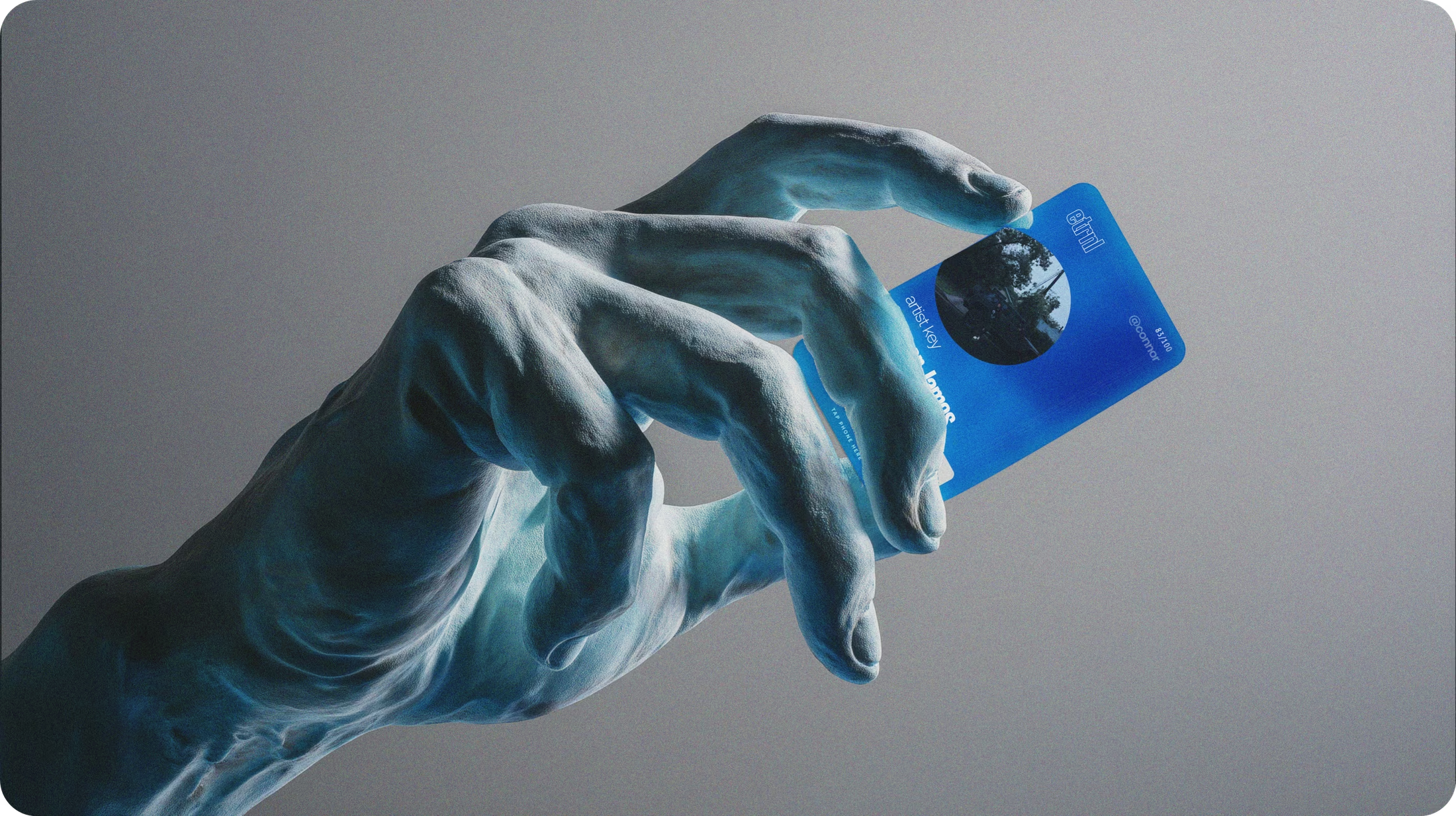
A blue ETRNL Artist Key held as a finished physical collectible

Founding Product Designer · Sep 2025–Apr 2026

ETRNL

Signed Artist Keys turned physical music merch into collectible identity, commerce, and digital activation.

Timeline
Sep 2025–Apr 2026
Role
Founding Product Designer
Scope
Product, brand, physical, launch
Team
Two-person core team
Process & contextThe product bet, role chronology, key decisions, and supporting detail

Context

From NFC utility to artist identity

ETRNL began as NFC keychains for music access. I proposed a sharper product bet: signed Artist Keys that worked as collectible identity, commerce, and digital activation. I led the system from physical prototype through app onboarding, access flows, and launch.

Role
Founding Product Designer
Scope
Product, brand, physical, launch
Team
Two-person core team

Key decisions

The work was a sequence of product choices, not a visual rebrand.

01

Reframe the category

Moved the product from NFC merchandise into collectible artist identity.

02

Make ownership visible

Made the physical object a status and access artifact, not just a link trigger.

03

Connect both sides

Linked physical ownership to digital activation, creator commerce, and an ongoing fan relationship.

04

Make activation clear

Balanced premium artist culture with a clear activation flow that worked in one tap.

Rejected / explored directions

The first product made the technology more visible than the relationship.

We explored chain-based merch, marketplace patterns, access tags, and social camera formats. They proved NFC could trigger content, but the formats either felt like utility hardware or asked the fan to understand too much before caring. The signed Artist Key was stronger because it communicated artist, identity, scarcity, and access at a glance.

Early direction: the technology and merchandise category led the experience.
Exploration: an access tag could feel premium, but it still lacked the immediate artist identity of the final Key.

Decision 01

Why keychains became collectible Artist Keys

A keychain said how the technology worked. A signed, numbered card said who the fan belonged with. I shifted the object toward a familiar collectible format, then used color series, artist imagery, signatures, and editioning to make ownership visible before activation.

The final system turned each artist into a recognizable series while preserving one collectible family.
Signature and editioning made access feel owned rather than merely triggered.
The system moved beyond renders into physical tests for material, scale, tap placement, and print finish.

Decision 02

Why identity and access mattered more than NFC

The tap needed to feel like recognition, not scanning a chip. The activation flow identified the object, revealed the signed artist identity, and added it to the fan’s vault. NFC disappeared into one understandable gesture; the relationship became the product.

One sequence: scan, recognize, reveal the artist identity, and confirm ownership.
The detailed activation path joined the physical object to a persistent place in the fan’s vault.

Decision 03

How the object activated a digital product relationship

Activation was the beginning, not the finish. An Artist Key opened an artist world where fans could access releases, exclusive media, products, and future drops. For creators, the same object connected identity to a storefront and purchase-to-unlock model.

One connected surface: Artist Key, product, release, purchase-to-unlock gate, and creator storefront.
The web platform gave the physical system a clear front door for discovery, purchase, and access.

Product system

Physical ownership became an ongoing artist relationship.

01

Own

A signed, numbered Artist Key communicates identity before the phone enters the story.

02

Activate

An NFC tap identifies the object and brings the artist relationship into the app.

03

Access

The fan enters an artist world with releases, media, drops, and owned collectibles.

04

Participate

Storefronts and purchase-to-unlock mechanics extend ownership into creator commerce.
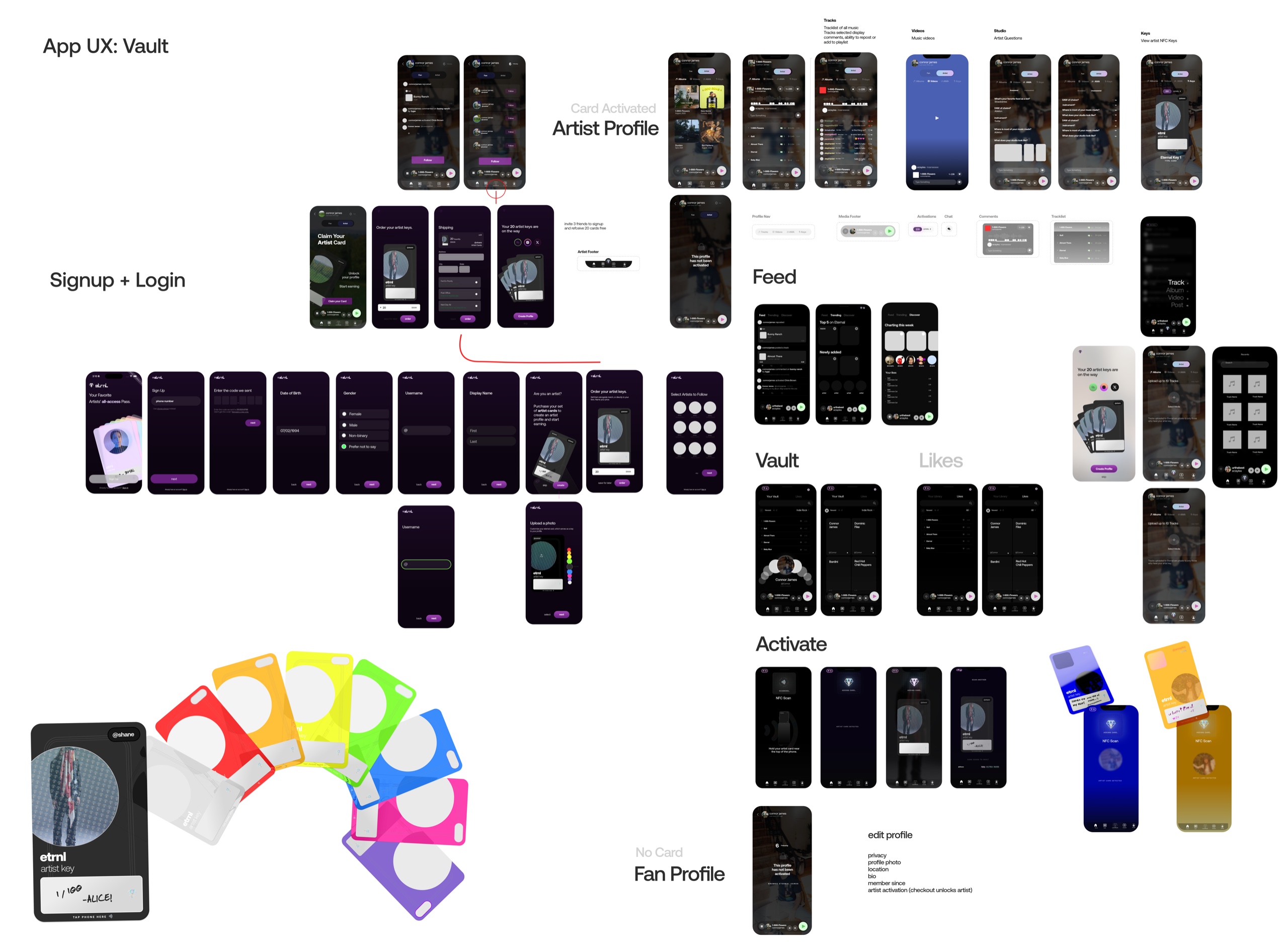
Complete ETRNL product architecture including onboarding, profiles, vault, feed, and activation

The product architecture connected activation, fan identity, artist profiles, owned collectibles, discovery, and commerce.

Launch / shipped work

The thesis became a testable physical and digital system.

The company ran out of runway before the new direction could be validated at scale, so I do not present the market thesis as proven. The direct evidence is the system itself: physical prototypes, working activation logic, complete product flows, creator commerce, and a launch expression built around one coherent object.

  • 01Produced physical card prototypes and tested NFC tap zones, material, scale, and editioning.
  • 02Designed the activation, onboarding, vault, artist profile, release, and discovery flows.
  • 03Defined creator storefronts and purchase-to-unlock mechanics around the Artist Key.
  • 04Carried the product thesis into the web platform, brand system, and launch campaign.

Complete body of work

Product, physical system, brand, and launch

Interface, collectible-format, creator-commerce, campaign, and launch studies across the complete ETRNL system.

Color-coded series made individual artists distinct while keeping the collection recognizable.
The stretched display system gave the product a graphic voice beyond conventional music-tech branding.
An early camera-filter direction explored how ownership could become visible in fan-made media.
Creator-facing campaign for setting a price across physical products and music unlocks.
Modular launch directions translated the same purchase-to-unlock model across releases.
A product-flow study connecting the physical Key to the artist storefront and purchase-to-unlock access.
Catalog studies for the fan vault and owned library across light and dark modes.
Artist profile exploration connecting music, studio stories, video, and owned Keys.
Discovery studies for artists, local trends, and collectible releases.
The full creator proposition: make the card, upload the work, set the price, and order the physical set.
Early color and transparency studies for the Artist Key series.
Metallic finish and signature studies.
Production-bundle direction with holographic wrapping.
The full color-series lineup.
A monochrome geometric system gave each series a distinct reverse side.
Renaissance access-tag exploration in gold.
Alternate material and color direction with the tap instruction embedded in the object.
Alternate physical prototype tested against the phone interaction and card proportions.
Scan-moment art direction for the detected-card state.
App-entry direction positioning ETRNL as an all-access pass.
Camera-led growth-loop concept based on the visual identity of each Artist Key.
Campaign study connecting creator-owned cards and fan participation.
A direct social invitation built from the collectible system.
The personalized-card idea translated to out-of-home scale.
Renaissance-inspired creator campaign direction.
Large-scale mural study positioning the card as a cultural artifact.
Artist Key launch direction in Los Angeles.
A collection-first billboard direction.
Renaissance imagery connected access, ownership, and cultural permanence.
An editorial format extended the system into artist stories and studio culture.
The complete reverse-side system across the collection.
Collectible render exploration.
Alternate collectible-series render.
Additional environmental study for the card system.

Complete brand book

38 pages · January 2026

What I learned

The technology only mattered when it deepened the relationship.

01

Physical-digital products need a clear reason to exist beyond novelty.

02

NFC is not the product; the fan relationship is.

03

The object has to communicate identity before the user taps it.

04

Product framing matters as much as interaction design.

YearSep 2025–Apr 2026
RoleFounding Product Designer · Brand, product, physical, and launch · Full-time
DeliverablesProduct strategy, Artist Key system, UX/UI, physical prototyping, creator commerce, launch

2026 CONNOR LEE

LOS ANGELES, CA