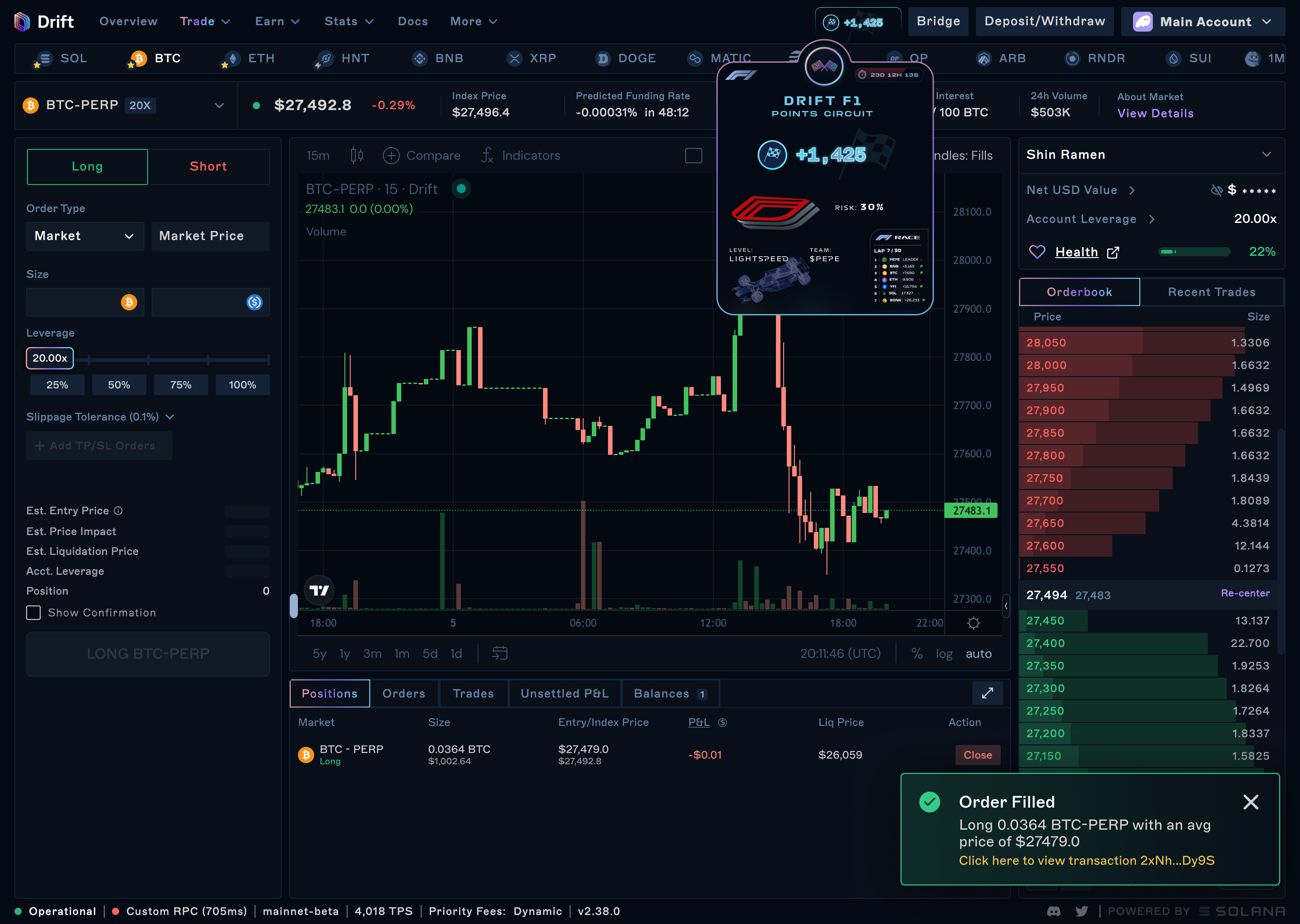
Drift trading interface with an expanded F1 points badge showing points, risk, level, team, and race position

PRODUCT · Dec 2023 – Jan 2024

Drift

A Driver identity system that made points legible inside the trading loop

Timeline
Dec 2023 – Jan 2024
Role
Two-week design trial - product UX/UI
design trial
2 weeks
progression levels
5
Process & contextStrategy, decisions, outcomes, chronology, and sources

Context

Drift was exploring points as an onchain reward mechanism for trading, DLP, referrals, and borrowing/lending. The strategic risk was points fatigue: a separate rewards destination could feel detached from the behavior it was meant to reinforce. The creative opportunity was to put users in the driver's seat and make Drift feel like a homebase, not another points tab.

Product decision

Put traders in the driver's seat without adding another destination. I designed a close-to-open Driver badge inside the exchange so earning feedback stayed realtime, then used racing language to organize points, volume, maker/taker behavior, risk, rank, and time-bound progression. Asset teams, circuits, and tournaments remained a deliberately staged extension rather than MVP complexity.

Trial outcome

The trial produced a coherent feature concept across the global navigation, trading view, and points dashboard: an earning entry state, realtime feedback, a compact hover, expanded badge detail, five status levels, and a longer-term circuit/leaderboard model. The badge could be populated from observable behavior—primary asset, leverage/risk tolerance, notional volume, and trade count—without making the user leave the market. This was exploratory trial work, not a shipped Drift engagement.

2 weeks
design trial
5
progression levels
4
behavior signals
3
connected product surfaces
ScopeProduct Strategy, UX/UI Design, Interaction States, Progression System, Visual Concept
Sources & prototypes

Key decisions

Keep the MVP inside the trading loop

A compact points control and close-to-open badge live in the product chrome, so earning and progress stay visible while a trader is already making decisions. The first release explains points before adding a new social destination.

Compress status into one Driver badge

Points, countdown, role, risk, level, primary asset, and race standing become one inspectable object instead of a stack of disconnected widgets. The badge can open for detail, then collapse back into the trading surface.

Turn trading behavior into identity

Primary asset, leverage, notional volume, and trade count give the badge an understandable relationship to how someone participates in the market. Volume tiers and maker/taker roles make progression feel earned rather than arbitrary.

Stage the social layer after the core loop

The exploration extends from the MVP badge into circuits, asset-based teams, custom teams, wallet invites, tournaments, and separate maker/taker leaderboards—an organic growth layer to add once points and earning are clear.

Refining the badge from a volume meter into a compact, persistent trading identity.

01

Give points a product home

The dedicated dashboard turns points into something a trader can understand over time: earned balance, historical movement, active positions, and a direct path back into the market.

A points overview connected to the account and its active trading positions.

02

Close the earning loop

The entry state explains how to begin, while the expanded badge reveals what the compact control is carrying: points, time, risk, level, team, and live race position.

Before earning: deposit guidance, role selection, and a preview of the Driver badge.
After earning: one inspectable badge brings the program's status into the live exchange.

03

Turn activity into identity

The system moves beyond a balance. Race progress, level tiers, fee behavior, and team participation give the badge a changing identity tied to how someone trades. The team and circuit states are shown as a future community layer, not required MVP scope.

Race position and stage progress.
Five levels tied to participation and fee behavior.
Team identity built from shared trading activity.

04

Keep the signal legible at every scale

The smallest control had to read immediately in Drift's dense trading chrome, while still carrying enough visual character to invite inspection. Reward-state color stays distinct from the red/green semantics of real funds, so the badge can feel expressive without confusing a trader about money.

Compact points states tested for contrast, hierarchy, and earned emphasis.

05

A visual language for the circuit

Crossed flags, spectral gradients, and neon streaks gave the feature a distinct racing atmosphere while remaining compatible with Drift's dark exchange interface. The system was designed to make trading feel more like participation in a shared raceway than another generic points program.

The points program's crossed-flags identity and launch atmosphere.

2026 CONNOR LEE

LOS ANGELES, CA